
Planning for 2027? Start by looking back on 2026. Then choose a priority, define what progress would look like, and make room for the first small action.
To set New Year goals you can follow through on, connect what matters to you with what fits your life. This guide takes you from reflection to a measurable goal, a realistic first week, and regular reviews. You can use a notebook, a spreadsheet, or the optional Notion templates below.
Your plan in four steps
Reflect → Choose → Plan → Review
Leave with one priority, one clear goal, a first action, and a time to check in. You do not need to plan every part of your year today.
Table of Contents
Reflect on the year before setting goals
Before deciding what to change, notice what you want to keep. Reflection can include ordinary moments, unfinished efforts, difficult experiences, and the support you needed. You do not have to turn everything into a lesson.
- Which moments or efforts mattered to me this year, and why?
- Which people, routines, or places helped me feel supported?
- What repeatedly drained my time or energy? What could I influence?
- What would I like more of, and less of, next year?
If remembering feels difficult, look through your calendar, photos, or notes. A few bullet points are enough. Finish with three short statements: one thing to keep, one thing to change, and one priority to explore.
Example: an insight worth carrying forward
“I enjoyed talking with people while traveling, but I often avoided conversations because I lacked confidence in Spanish. I want to make more room for learning and connection.”
Choose one or two priorities
Your reflection may suggest changes in health, relationships, money, work, or learning. You do not need a goal in every category. As a starting point, choose one or two priorities that matter now and fit the time and energy you have.
- Meaning: Would I still want this if nobody else saw the result?
- Capacity: What commitments or constraints must the plan fit around?
- Trade-off: What would I reduce, postpone, or stop to make room?
Some priorities are better expressed as a boundary or routine. “Keep one evening free each week” does not need to become an ambitious annual project.
Example: choose the focus
Priority: Feel more comfortable connecting with people in Spanish.
Capacity: Three short practice sessions a week.
Trade-off: Replace some evening scrolling with practice.
Turn a priority into a measurable goal
A resolution describes a direction; a goal gives you something specific to work toward. SMART is a useful check: specific, measurable, achievable, relevant, and time-bound. You can use it without building a complicated planning system.
Example: from “learn Spanish” to a clear goal
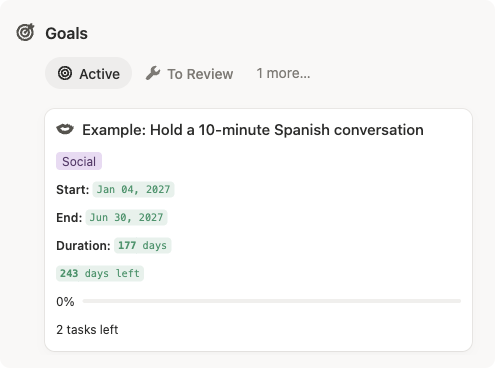
Goal: By June 30, 2027, hold a 10-minute conversation in Spanish about everyday topics with a language partner.
Why it matters: I want to feel more comfortable connecting with people when I travel.
Success measure: Complete the conversation and note which topics I could discuss and where I needed help.
First milestone: Arrange an initial practice conversation during January.
Match the target to your starting point. If you are a complete beginner, make the first milestone smaller. If your goal depends on someone else, separate the result you hope for from the actions you can control.
Track activity and outcomes separately. Completing three lessons is useful activity; having a conversation is evidence of the intended outcome. A task-completion percentage cannot tell the whole story.
Plan your first week and a fallback
Give your goal a place in an ordinary week. Choose a small next action, decide when it will happen, and prepare for a likely obstacle. You can add later milestones as you learn.
Example: a first week that fits
- First task: Choose a practice resource and book a short introductory session with a language partner.
- Practice time: Tuesday, Thursday, and Saturday after breakfast, for 15 minutes.
- Likely obstacle: An unexpectedly busy morning.
- Fallback: Review five useful phrases later that day, then return to the usual schedule.
Write your fallback as an “if–then” plan: “If I miss my planned session, then I will do a smaller version at the next available time.” A fallback keeps the next step clear; it does not need to preserve a perfect streak.
A calendar reminder can help you return to the plan. Use a tool you already check rather than setting up several new apps before you begin.
Review your progress and adjust
Choose a regular check-in time. A brief weekly review helps you decide what to do next; a monthly review gives you room to reconsider the goal itself.
- Each week: What did I do? What changed? What is one useful next action?
- Each month: What evidence shows progress toward the outcome? Is the goal still relevant and realistic?
- After a break: Keep what still matters, reduce the next step if needed, and adjust dates deliberately.
For the Spanish goal, you might record completed practice sessions each week and try a short conversation each month. Use what you notice to choose the next topic to practice. If your circumstances change, pausing or revising the goal is a decision you can make.
At the end of the year, your notes become useful material for the next reflection. Keep completed goals and their linked tasks together so you can see both the effort and the result.
Use AI to think through your resolutions
If you are thinking, “I would like to set new resolutions that I can actually keep, ask me a few questions about my life and priorities.” an AI chat can help you work through the steps. The useful part is the conversation before the plan: your priorities, available time, and likely obstacles.
Use the prompt below in an AI chat of your choice. The guide works without AI, and any suggestions are a starting point for your judgment. Share only information you are comfortable entering into that service.
Reusable AI planning prompt
Copy the text below into a new chat. It works for any planning year; give the year when the assistant asks.
Help me set New Year resolutions that fit my life and that I can realistically follow through on. Act as a practical planning partner.

Start with questions, not recommendations. Ask one question at a time and wait for my answer. Ask about:
- What mattered during the past year and what I want to keep or change.
- My current commitments, available time, energy, and constraints.
- What I want more of or less of, and why it matters to me.
- What has made previous plans difficult and what support is available.

If I have already written a yearly reflection, ask me to share only the takeaways I am comfortable sharing, then ask about any missing context. Do not make me repeat the whole exercise. Do not ask for identifying, medical, or financial details.

Once you have enough context, summarize the priorities you heard and ask me to confirm or correct them before proposing goals. Do not invent facts about me.

After I confirm, help me choose one or two priorities. For each, suggest:
1. A specific outcome and a realistic target date, based on my starting point.
2. A way to measure the outcome separately from completed tasks.
3. A small first milestone and actions for the first week that fit my available time.
4. A likely obstacle and an if-then fallback.
5. A simple weekly check-in and monthly review.
6. What I might postpone or reduce to make room.

Distinguish my choices from your suggestions. If the plan exceeds my capacity, reduce it. Some priorities may be better served by rest, a boundary, or a routine rather than a new achievement goal. End by asking which first action I want to commit to. If I am unsure, offer a smaller option instead of adding more goals.
Before accepting the result, check that the plan fits your actual week, the target matches your starting point, and the success measure describes the outcome you care about. Correct assumptions and remove goals you do not want.
Put your plan into Notion
If you want a place to keep your answers and plan together, these are optional DIY resources from EfficiencyNest. You can also follow the same process on paper or in a spreadsheet.
Free: Yearly Reflection 2026
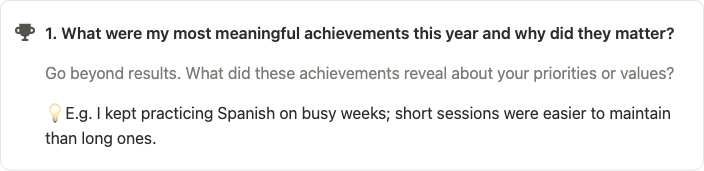
Look back on 2026 with guided questions and finish with your keep/change/priority summary. Choose this if you want a simple reflection exercise before deciding what comes next.
Paid: Resolution Tracker
Connect guided reflection with goals, linked tasks, and ongoing check-ins in one Notion workspace. Choose this if you want to keep using the same system throughout the year.
The tracker includes its own reflection guide. If you have already completed the free template, bring your key takeaways and use the deeper questions selectively; you do not need to start again.
For a broader view of the available resources, visit the Notion template collection. If you run a small service business and your priorities involve repeated lead follow-up or client onboarding, explore EfficiencyNest’s workflow automation services.
Frequently Asked Questions
How do I set realistic New Year goals?
Reflect on what matters, choose one or two priorities, define a measurable outcome, and plan a small first week. Check the plan against your time, energy, and existing commitments before adding more.
What is the difference between a resolution, a goal, and a habit?
A resolution is a direction or intention, such as making more room for learning. A goal describes an outcome, such as holding a 10-minute conversation in Spanish by a chosen date. A habit is a repeated action that can support it, such as practicing after breakfast.
What if I have already completed a yearly reflection?
Use your key takeaways as the starting point. Choose one priority and move into goal setting. Return to reflection questions only where you need more clarity.
What should I do if I fall behind?
Review whether the goal still matters and what made the plan difficult. Choose a manageable next action, adjust the schedule or target when needed, and continue from your current situation.
Can I use this process after January?
Yes. Start with your current circumstances and choose a realistic target date. Reflection, planning, and review can be useful whenever you want to change direction.
Do I need Notion or an AI tool?
No. A notebook, calendar, or spreadsheet is enough. Notion can keep reflection, goals, tasks, and reviews together; an AI chat can help you think through the questions. Both are optional.