Automation isn’t just a tech buzzword anymore — it’s becoming the backbone of how businesses and individuals save time, cut costs, and scale their impact. With the rise of AI, today’s automation tools are smarter, more accessible, and more customizable than ever.
Table of Contents
But with so many platforms on the market, how do you know which one is right for you? Should you stick with a popular SaaS platform like Zapier, explore enterprise options like UiPath, or take full control with a self-hosted tool like n8n?
In this guide, we’ll break down the 7 best AI automation tools for 2025, compare their strengths and weaknesses, and help you decide which fits your needs best.
Why AI Automation Tools Matter in 2025
The demand for automation has exploded in the last few years. A few reasons why:
- Time Savings: Repetitive tasks like sending emails, syncing data, and generating reports eat into productive hours.
- Cost Efficiency: Businesses can save thousands per year by replacing manual workflows with AI-driven automation.
- Smarter Workflows: AI adds intelligence to automation — from natural language processing to predictive analytics.
- Data Privacy & Control: More teams are moving toward self-hosted solutions to own their workflows and data.
Simply put: if you’re not automating in 2025, you’re falling behind.
The 7 Best AI Automation Tools for 2025
Here’s our curated list of the top platforms to consider this year.
1. Zapier — The Popular SaaS Choice
Zapier has long been the go-to automation platform. It integrates with over 5,000+ apps and makes it incredibly easy for non-technical users to create “Zaps” (automated workflows).
Strengths:
- Wide range of integrations
- User-friendly interface
- Strong support & documentation
Weaknesses:
- Costs grow quickly as usage scales
- Data flows through Zapier’s servers (limited privacy)
Best for: Freelancers, small teams, and beginners who want quick wins without technical setup.
2. Make (formerly Integromat) — Visual, Flexible Workflows
Make stands out for its visual workflow builder that lets you map complex automations with drag-and-drop nodes.
Strengths:
- More flexible than Zapier
- Lower cost per task compared to Zapier
- Rich scheduling & branching options
Weaknesses:
- Steeper learning curve for beginners
- Not self-hosted
Best for: Power users who need more flexibility than Zapier without jumping to open-source tools.
3. n8n — The Open-Source Self-Hosted Powerhouse
n8n is quickly becoming a favorite among developers, entrepreneurs, and automation enthusiasts. Unlike SaaS tools, you can self-host n8n on your own server (e.g., DigitalOcean).
Strengths:
- Open-source & free to self-host
- Unlimited workflows, no “per-task” pricing
- Strong privacy & data ownership
- Growing community + integrations
Weaknesses:
- Requires a bit of setup (server, SSL, etc.)
- Less “plug-and-play” than Zapier
Best for: Anyone who wants full control over their automations, cost savings at scale, and privacy.
👉 Want a step-by-step guide? Check out our ebook:
How to Set Up Self-Hosted n8n on DigitalOcean →
4. Microsoft Power Automate — Best for Enterprises
Built into Microsoft’s ecosystem, Power Automate integrates seamlessly with tools like Outlook, Teams, and SharePoint.
Strengths:
- Enterprise-grade security
- Tight integration with Microsoft apps
- AI Builder adds advanced functionality
Weaknesses:
- Licensing can be complex
- Limited appeal outside Microsoft ecosystem
Best for: Enterprise teams already invested in Microsoft 365.
5. UiPath — AI-Driven RPA Leader
UiPath specializes in Robotic Process Automation (RPA) — automating repetitive desktop and enterprise processes.
Strengths:
- Excellent for structured, repetitive tasks
- Advanced AI integrations
- Strong in compliance-heavy industries
Weaknesses:
- High cost
- Requires skilled setup & management
Best for: Enterprises needing large-scale automation across legacy systems.
6. Automation Anywhere — Scalable Business Automation
Another leader in RPA, Automation Anywhere offers AI-driven bots for end-to-end business process automation.
Strengths:
- Powerful for enterprise-scale needs
- Scalable, flexible deployments
- Strong support ecosystem
Weaknesses:
- Expensive
- Best suited for larger organizations
Best for: Corporations looking for enterprise-level automation solutions.
7. Jasper AI — AI for Marketing Automation
While not a traditional workflow automation tool, Jasper uses AI to automate content creation and integrates with marketing stacks.
Strengths:
- Great for content teams
- Speeds up copywriting & ideation
- Integrates with marketing workflows
Weaknesses:
- Narrow use-case (mostly marketing content)
- Subscription costs
Best for: Marketing teams and agencies looking to scale content production.
Comparing the Tools — Which One Should You Choose?
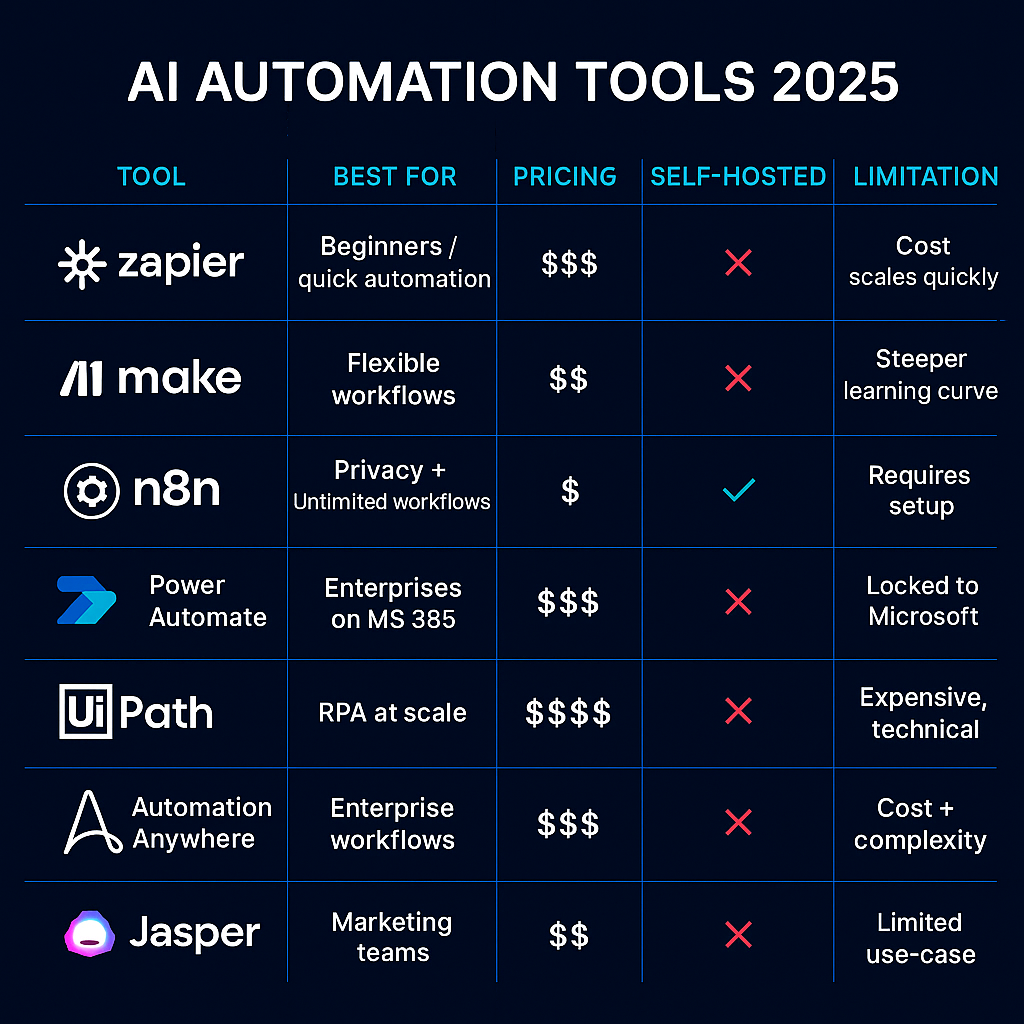
Summary:
- If you’re new → Zapier or Make.
- If you’re enterprise → UiPath or Power Automate.
- If you want privacy + cost savings → n8n (self-hosted) is the winner.
When to Choose Self-Hosted Automation (n8n)
Self-hosted automation makes sense if you:
- Care about data privacy & control
- Want unlimited workflows without SaaS pricing limits
- Prefer flexibility to integrate custom APIs
- Need an automation hub that scales with your business
👉 Learn exactly how to set up n8n on your own server in our ebook:
How to Set Up Self-Hosted n8n on DigitalOcean →
Final Thoughts
AI automation tools in 2025 are more powerful than ever. From simple drag-and-drop platforms like Zapier to enterprise-grade RPA systems like UiPath, there’s a tool for every use-case.
But if you want affordable, private, and customizable automation, self-hosted n8n is a clear winner.
Next Step → Get your copy of our step-by-step ebook and launch your own self-hosted automation hub today.